What It Takes to Succeed as a College Wrestler

College wrestling has a way of finding every weak spot. It tests lungs, legs, discipline, sleep habits, grades, patience, and pride, often before breakfast.
Succeeding at this level takes more than being tough in the third period. Talent matters, but it does not carry a wrestler through a long season, a hard weight cut, a brutal finals week, or a lineup battle with a teammate who wants the same spot. The wrestlers who last learn how to train, recover, study, compete, and handle pressure without losing themselves in the process.

The daily work matters more than the big moment
Most people see the match. They do not see the 6 a.m. lift, the extra stance motion after practice, the ice bath, the film session, or the lonely jog when the campus is still quiet.
A college wrestler lives in routine. Practice is not just showing up and going hard. It means drilling with purpose, listening to coaches, fixing small mistakes, and pushing through sessions where the body feels flat.
The best wrestlers treat basics like they never outgrow them:
Keeping a strong stance
Hand fighting with pressure
Finishing shots cleanly
Getting off bottom fast
Wrestling through the edge
Staying ready in every scramble
These details decide matches. A sloppy finish can turn into two points the other way. A lazy stand-up can become a rideout. A slow restart can cost a period.
Consistency beats occasional intensity. Anyone can have one great practice after a bad loss. The challenge is stacking good days when nobody is watching and no lineup spot is guaranteed.
That daily work also builds trust. Coaches notice who takes warmups seriously. Teammates notice who keeps wrestling when tired. Over time, those habits shape a wrestler’s reputation in the room.
College wrestling demands smart physical preparation
A strong college wrestler is not just strong. They are durable, explosive, mobile, and conditioned for repeated high-effort bursts. Matches require power, but they also require the ability to recover quickly between exchanges.
Strength training supports wrestling, but it cannot replace it. Squats, pulls, presses, carries, and core work build a base. Mat conditioning teaches the body how to fight through the exact kind of fatigue a match creates.
Good preparation usually includes:
Strength
Building the hips, back, legs, grip, and trunk needed to control positions.
Conditioning
Training the heart and lungs for hard hand fighting, scrambles, rides, and late-match attacks.
Mobility
Keeping shoulders, knees, hips, and ankles ready for awkward positions.
Recovery
Sleeping enough, eating enough, hydrating, and taking injuries seriously.
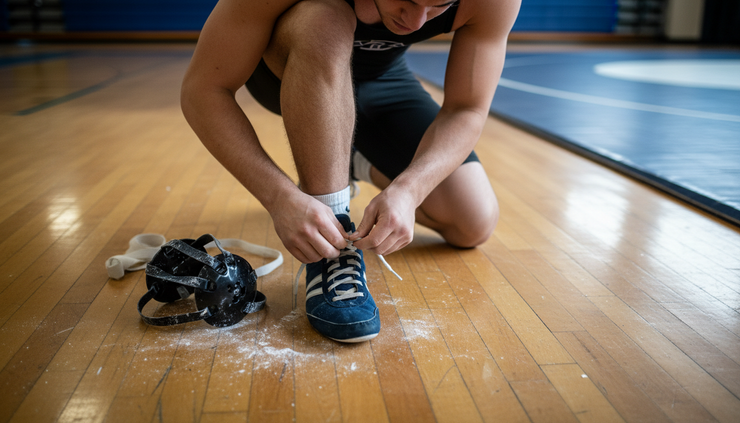
Weight management also plays a major role. Cutting weight poorly can drain energy, hurt focus, and turn normal practices into survival. Successful wrestlers learn to work with athletic trainers, coaches, and nutrition guidance instead of guessing.
A wrestler who feels strong in January usually made better choices back in September. That means eating real meals, keeping weight within a reasonable range, and not treating recovery like an optional extra.
Academics and time management are part of the sport
Being a college wrestler means living two schedules at once. There is the athletic schedule, with lifts, practices, travel, weigh-ins, treatment, and competition. Then there is the academic schedule, with classes, labs, papers, exams, group projects, and office hours.
The wrestlers who stay eligible and sane do not wait for free time. They plan.
A normal week can fill up fast. Travel can take away a full weekend. A midweek dual can cut into study time. Morning lifts can make late-night cramming even worse. Without structure, stress builds quickly.
Strong habits help:
Use a calendar for practices, classes, deadlines, and travel.
Start assignments early during competition season.
Sit near the front and engage in class.
Communicate with professors before travel, not after missing work.
Use study hall or tutoring before grades become a problem.
This might not sound as exciting as a takedown in overtime, but it matters. Academic discipline protects athletic opportunity. A wrestler who cannot manage classwork will eventually feel that pressure on the mat.
There is also pride in handling both. College wrestling asks athletes to carry responsibility in public and private. Doing the work in class is part of that standard.
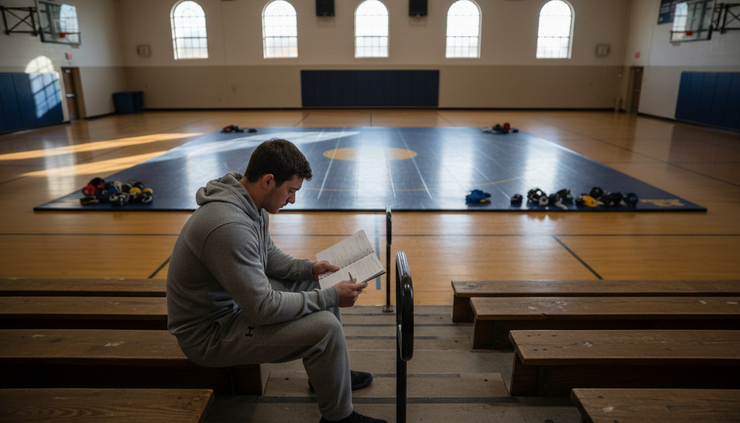
Mental toughness is built through pressure
College wrestling brings pressure from every direction. A starter may feel the stress of keeping a spot. A backup may feel stuck behind a ranked teammate. A freshman may struggle with losing after years of being the best in their high school room.
Losses hit hard because wrestling feels personal. There is no one else to blame when the referee raises the other athlete’s hand. That can be painful, but it is also what makes growth so direct.
Mental toughness does not mean pretending losses do not hurt. It means learning from them without letting them define the next week.
Good wrestlers develop emotional habits:
Watch film without making excuses.
Separate identity from results.
Respond to coaching without shutting down.
Keep competing after giving up points.
Find confidence in preparation, not hype.
The college season is long enough that every wrestler gets humbled. The difference is what happens after. Some spiral. Some blame. Some avoid hard rooms. The ones who improve come back to practice with a plan.
A strong mind also knows when to ask for help. Talking to a coach, athletic trainer, counselor, teammate, or trusted mentor is not weakness. It is part of staying healthy enough to compete well.
The team shapes the individual
Wrestling is an individual sport on the scoreboard, but college wrestling is built inside a team. Practice partners make each other sharper. Older athletes teach younger ones how to handle travel, cutting, lifting, and competing. The room has a culture, and every wrestler adds to it.
A good teammate gives hard, honest work. They do not coast during drills. They do not injure partners through careless wrestling. They celebrate teammates’ wins, even when they are fighting for the same lineup spot.
That can be difficult. College rooms are competitive by nature. Two wrestlers in the same weight class may train together every day while chasing one singlet. The healthy approach is simple, but not easy: compete fully, respect each other, and make the room better.

Leadership does not only come from captains. A redshirt freshman can lead by staying late to drill. A backup can lead by bringing energy to practice. An injured wrestler can lead by staying engaged and helping teammates prepare.
The room remembers effort. Over time, that respect becomes part of a wrestler’s confidence.
The real measure of success
Winning matters. College athletes compete to win matches, tournaments, conference titles, and national honors. Nobody trains that hard just to participate.
Still, success as a college wrestler is bigger than a record. It shows up in how a wrestler lives. Can they handle pressure? Can they take coaching? Can they manage time? Can they recover from failure? Can they keep promises to themselves when the season gets hard?
The sport gives clear feedback. Skip recovery, and the body answers. Ignore grades, and eligibility gets tight. Lose focus in the third period, and the score changes. That honesty is demanding, but it is also useful.
A successful college wrestler becomes dependable. They learn to do hard things on schedule. They learn that confidence comes from preparation. They learn that setbacks are not final unless they stop working.
The takeaway is simple: college wrestling rewards the complete athlete. Strength helps. Skill helps. Toughness helps. But the wrestlers who thrive combine all of it with discipline, humility, and steady habits, day after day.


Comments